

This is the research diary of researcher Lisbeth
Klastrup, since february 2001 sharing her thoughts on life, universe, persistent online
worlds, games, interactive stories and internet oddities with you on the www.
I am currently on leave from the IT University
of Copenhagen, and from aug. 2006 - aug. 2007 working as Associate Research Professor at the Center for Design Research Copenhagen, an independant center situated at the School of Architecture. During this year, I will be working on a book about the development of aesthetics, design and interaction on the WWW, together with colleague Ida Engholm.
My blog often reflects how busy I am in general, so posting may be pretty irregular, as well as my potential response to comments. But I read them!
My list of publications.
My official homepage at ITU.
Contact:
lisbethATklastrupDOTdk
February 2001 March 2001 April 2001 May 2001 June 2001 July 2001 August 2001 September 2001 October 2001 November 2001 December 2001 January 2002 February 2002 March 2002 April 2002 May 2002 June 2002 July 2002 August 2002 September 2002 October 2002 November 2002 January 2003 February 2003 March 2003 April 2003 May 2003 June 2003 July 2003 August 2003 September 2003 October 2003 November 2003 December 2003 January 2004 February 2004 March 2004 April 2004 May 2004 June 2004 July 2004 August 2004 September 2004 October 2004 November 2004 December 2004 January 2005 February 2005 March 2005 April 2005 May 2005 June 2005 July 2005 August 2005 September 2005 October 2005 November 2005 December 2005 January 2006 February 2006 March 2006 April 2006 May 2006 June 2006 July 2006 August 2006 September 2006 October 2006 November 2006 December 2006 January 2007 February 2007 March 2007 April 2007 May 2007 June 2007
Fellow research bloggers
-Denmark
Jesper Juul
Gonzalo Frasca
Martin Sønderlev Christensen
Jonas Heide Smith
Miguel Sicart
Mads Bødker
ITU blogs
-Norway
Jill Walker
Torill Mortensen
Hilde Corneliussen
Anders Fagerjord
-The World
Terra Nova (misc, joint)
GrandTextAuto (US, joint)
Mirjam Paalosari-Eladhari (SE)
Jane McGonigal (US)
Patrik Svensson (SE)
Elin Sjursen (NO)
Adrian Miles' Vog blog (AUSTR.)
Other Related Blogs
Mediehack
Hovedet på Bloggen
Bookish
Tempus Tommy
Flickwerk
Jacob Bøtter
Corporate Blogging
Fellow Researchers, non-blog
-Denmark
Susana Tosca
T.L. Taylor
Espen Aarseth
Soeren Pold
Ida Engholm
Troels Degn Johansson
-Norway
Ragnhild Tronstad
-Sweden
Anna Gunder
Jenny Sunden
Mikael Jacobsson
-Finland
Aki Jarvinen
Markku Eskelinen
Raine Koskimaa
©Lisbeth Klastrup 2001-2007

It happens this weekend and is produced by The Interactive Institute.
(should read A LOT of blogs more regularly, but time, time!)
A member of the staff here at ITU informed me that this site has made it to the top 30 of most visited sites at ITU, which puzzled me a bit. Checking out the ITU stats which are available on the internet revealed that the counts they have there of this site are MUCH higher than the ones my own counter shows. So someone is obviously wrong, but who? Unfortunately the stats person isnt in today, but I look forward to having the mystery solved. I dont like the idea of "secret" visitors somehow, though I shouldn't really bother.
And, btw, the person who referred me to the stats info, saids casually: "Of course I had to check your page out, and then I found out it was just this kind of Big Brother thing!". Guess that is also one pov on blogs.
Tomorrow I will be participating in - and giving a talk at a seminar on Computer Game Research at University of Copenhagen.
Sunday evening, after spending the day preparing some chapters of my thesis for a soon-to-visit guest from abroad, I will have visitors from a distance learning class in Århus in StoryMOO, my local virtual world. I will be giving them a tour of the place and talking about creating narratives in virtual environments.
In Denmark, these three years of ph.d. work, is actually called the "Ph.D. education". We are supposed to take courses ourself, we are supposed to learn how to do research. In some sense, we are still at school, yet everyone is expecting us to behave like grown-ups and be very responsible about our own thing. It is a strange "coming of age" time, and I for one cant wait to get it over and done with. I think I know how to do research now, I know how to teach, and there is very few courses that would actually be able to teach me something new (in my own field, that is!), and perhaps most importantly: I know what to do to get on in the academic world. Honestly, right now, the value of the Ph.D. thesis to me mostly seems to be that it earns you a piece of paper, that will make it easier for you to get a job in the academic community. But like in RL (Real Life as in outside of university), when you apply for a job, and no one reads your Masters Dissertation when they examine your credentials, no one seems to actually need to read your Ph.D. thesis when you apply for a assistant professorship etc. They want to see articles, in the end, articles are what counts and the ph.d. thesis is just the bread underneath it all. So no need to butter it all up.
Deleuze in Cinema 2 is immensely obscure (as always?), but I think, he is eager to point out that at a minimum level you cannot make a sharp distinction btw actual and virtual. I want to use him to think about virtual worlds:
In virtual worlds, we are dealing both with a representation of reality and something that is reality in itself, because it does not point to something outside of itself (it is not "realistic" or a documentation of the real world), in a way just like the fiction film . Yet as soon as we have image - or language - we have representation, mediated "reality". What the virtual reality points to is "the world" itself, of which it is a part - it asks us to construct a universe by combining the parts we are presented with, in fact a kind of never accomplished hermeneutic circle of interpretation. This is an example of an image whose "nature is double", it is virtual and actual at the same time. The moment we interact in this represented reality, our actions are already moving into the past at the same time as we are constructing the future. It is not us, who cannot discern between what is real and what is not. It is in the nature of things themselves; they refuse to be either or. Neither Reality, nor just a representation of it.
Deleuze refers to Robbe-Grillet and Bergson, Robbe-Grillet and his idea of a nouveau roman. RG wants to let the objects speak for themselves and not be contamined by the human emotions attached to them. What he does is write and work in a constant process of construction and erasure: he describes the objects and then he erases them through a new and slightly different description of them. Out of this comes perhaps "narrative", the story of the man who describes the world. Bergson and his notion of duree, time not as cut up into chronological and measurable seconds, but time as a "strecthed" now, a constant movement from the past into the future. As when we listen to (classical) music: we can only understand it by combining the node we hear "now" with our memory of the nodes that came before. "Music" is what we experience in an anticipation of what is coming and an interpretation of what we have already heard. Is that similar to how we live a virtual world? Our experience of "worldliness" is a combination of what we have already actualised and what is yet to come, what is about to actualised and what will make new actualisations possible.
“The indiscernibility of the real and the imaginary, or of the present and the past, of the actual and the virtual, is definitely not produced in the head or in the mind, it is the objective characteristic of certain existing images which are by nature double. “
- Gilles Deleuze: Cinema 2 - The Time-Image, pp 69
But it costs $17 to buy it online :(, great service, but quite a lot of money for something whose quality it is difficult to judge.
A simulated environment that appears to have the characteristics of some other environment, and in which participants perceive themselves as interactive parts.
at http://www.atis.org/tg2k/_virtual_world.html (American National Standard for Telecommunications - Telecom Glossary 2000)
This is an area created on the computer which can be explored in three dimensions. The user navigates their way around with the use of the keyboard or mouse.
This found at Webwise, "The Internet made simple by BBC".
As Kalawsky93 explained, virtual environments (VE), also known as virtual reality, is a computer system that generates a three-dimensional graphical ambient known as virtual world, where the user experiences an effect called immersion (the sense of presence within the VE world), and he/she navigates through the virtual world and interacts with the graphical objects that reside within it, using special input/output devices.
This definition by someone working in the School of Cognitive and Computer Sciences.
Virtual reality: An artificial environment created with computer hardware and software and presented to the user in such a way that it appears and feels like a real environment. To "enter" a virtual reality, a user dons special gloves, earphones, and goggles, all of which receive their input from the computer system. In this way, at least three of the five senses are controlled by the computer. In addition to feeding sensory input to the user, the devices also monitor the user's actions. The goggles, for example, track how the eyes move and respond accordingly by sending new video input.
To date, virtual reality systems require extremely expensive hardware and software and are confined mostly to research laboratories.
The term virtual reality is sometimes used more generally to refer to any virtual world represented in a computer, even if it's just a text-based or graphical representation.
says the Internetnews.com Webopedia
Certain things are shared in common among all of the many inheritors of MUD1, and these things make up the core of what a mud is—and therefore, what a virtual world is today. These are:
1. A spatial representation of the virtual world
2. Avatar representation within the space
3. A sandbox to play in that offers persistence for some amount of the data represented within the virtual world
Anything that meets these criteria can profitably be called a mud for the sake of examining it and comparing features in the design to things that aren’t ashamed to use the term. And later
A mud is a spatially based depiction of a somewhat persistent virtual environment, which can be experienced by numerous participants at once, who are represented within the space by avatars.
This is found in the lexia "A Somewhat Strict Definition" at Raph Koster's website.
The software embodiment of the pseudo-collective object is a mediation tool based on a virtual world. This virtual world shares many of the defining characteristics of
Multiple User Domains (“MUDs,” Curtis 1992, Curtis & Nichols 1994), namely, that it is an interactive, multi-user, text-based virtual reality. The interactions among the users and the stable (or more-slowly-changing) organization of the surrounding environment create the “worldness” of the virtual world. The mediation tool differs from most other virtual worlds in a critical way, however. The typical virtual world is a simulated environment in which participants interact virtually, and independently of the external world. A simulation, that is, starts with seed values from the outside, and progresses of its own accord, executing its own internal logic. After some elapsed time, the observer can (if desired) compare the state of the simulation to possible states of the external world, and determine whether the simulation is an accurate model of the world. In the current case, however, the design of the virtual world (Zager 1999) is not a simulation. It is autopoietic (Maturana & Varela 1973) in nature, meaning that the virtual world stays structurally coupled to the world external to it, and hence the virtual world reflects changes to the state of the external world with commensurate changes to its own state.
as said by David Zager, Ph.D. in the article "Collaboration as an Activity - Coordinating with Pseudo-Collective Objects"
A nice metaphoric definition of virtual. And here you can search on virtual art projects.
------------------------------------
CALL FOR SWIMMERS
The Umpteenth Conference in a Copenhagen Swimming Pool
(UCCSP '02)
13-14. September 2002
Copenhagen Swimming Pool
CONFERENCE DESCRIPTION:
The conference should give the participants an opportunity to relax their
intellectual resources through physical aquatic exercises, with an aim to
bring their minds to a higher level of swimming harmony.
PREREQUISITES:
Swimming gear, preferably including goggles, towel, shampoo (optional).
CONFERENCE PROGRAM:
1: Arrival
2: Registration (location: ticket counter)
3: Clothes-stripping event (location: gender-specific changing-rooms)
4: Sanitizary workshop I (location: gender-specific under showers)
5: Main swimming conference (location: pool)
6: Sanitizary workshop II (location: under gender-specific showers)
7: Optional conference banquet (location: local café)
8: Conference closing remarks and departure
....etc
------------------------------
Sender: Audible books
Subject: Your computer can READ
....I dont want to open it lest I be disappointed. I'm currently dreaming of asking my computer to read all the books and articles, I need to (re)look at the next couple of months.
Even music icons have started to write a online diary. Read Moby who dreams of garlic rice.
It was the FAQ below that pointed me to the problem. Apparently, word always checks for the default printer as one of the first things, when it opens a document. If it cannot find the printer - or the driver for the printer locally - it crashes. I just tried removing the printer, and voila presto, had no problems opening my word files. But it's like opening a can of worms, it is not fun working with documents, when you cannot print them....The story continues. BRB.
Word 2000 Tips & Tricks looks like it has some neat tips for saving time, once you get the programme up and running, that is...
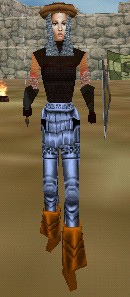
Meet Milagros, the character I am currently playing in EverQuest. One of the not so great design details of this world is that human-like female characters start out wearing hardly any clothes at all. So for several levels, I had to run around in the world displaying more or less all of my cute little butt to all players in site...I tried buying clothes pants (because they are cheap), but they turned out not to show visually on your character. Then I got a kind dwarf blacksmith to forge me some leggings, but they only covered the legs and behind partly. But, finally, now I just completed a class (Paladin) quest for pants which finally gave the visual representation of Milagros the appearance of a warrior, rather than that of a virtual version of Pamela Anderson as Baywatcher. Need I say it is much easier for me to get into a fighting group now?
Which reminds me: did I ever tell about the time I went with a Spanish friend to a Danish theatre? It was the person's first experience with a live Danish performance, and she almost had a heartattack when after the play, people started clapping - in unison! For her it was another proof of the almost too well-regulated communal Danish behaviour, very different from the more random behaviour of a Spanish audience. Almost no need to say that I have been thinking twice about changing my clapping habits after this...
Last week, by chance, I came across and purchased a video called "Dungeons & Dragons", which claimed to based on the Dungeons and Dragons game (sic). I have yet to see it (though according to role-playing filmbuff friend it sucks). I have always been interested in adaptations, the transferral of a story in one media to another media, so I'm trying to collate a list of "games made into films" for a future article on the subject. What is it you actually adapt, when you make a game-film? It cant really be the plot or the story (since games are not narratives, huh), so rather it must be the universe - or virtual world...- or characters; problem being that finite game characters are usually quite flat and the game universe not really that interesting if you cant interact with it yourself. So the films made so far are not very good, IMHO, perhaps for this reason. But could one imagine an interesting game-film concept? I am sure there is bound to be more of them around as games become a more and more intrinsic part of everyday popular culture.
Here is the list, I have so far: do you know of any others?
List of film made from games:
Dungeons & Dragons, 2000 (game: Dungeons & Dragons series?)
Resident Evil, 2002 (Game: Resident Evil)
Tombraider, 2001 (Game: The Tombraider Series)
Final Fantasy: The Spirit Within, 2001 (Game: The Final Fantasy Series, 1-10??)
Tron (1982) (which according to this source is "the first fusion of game and movie, an arcade hit based on a film that was based on the video game phenomenon"). Tron 2.0 should be coming out in 2003!
Street Fighter, 1995 (based on arcade game)
Super Marios Bros., 1993 (based on the original gameboy ? games)
And State of Emergency, based on the PS2 should be in the making, according to some rumours.
There is a discussion about games to film here.
You can sign up on the mailinglist at the site too.
Ladonia, proud, free and interactive! and situated between Denmark and Sweden, run by State Secretary Lars Vilks. Looks much like the other imaginary countries I have been looking at earlier.
Death Stories project
Walgblog (DK)
DK forskerblogs (DK)
klast at del.icio.us
Site feed Link (Atom)
Klastrup family?
****************

Buy our book
****************
Conferences
ACE 2007
Mobile Media 2007
MobileCHI 07
Perth DAC 2007
DIGRA 2007
AOIR 8.0/2007
****************
My Ph.D. thesis website:
Towards a Poetics of Virtual Worlds
****************
Misc
I also used to host & work in a world called StoryMOO.